Technology is making it easier than ever to get things done. And that’s becoming a problem.
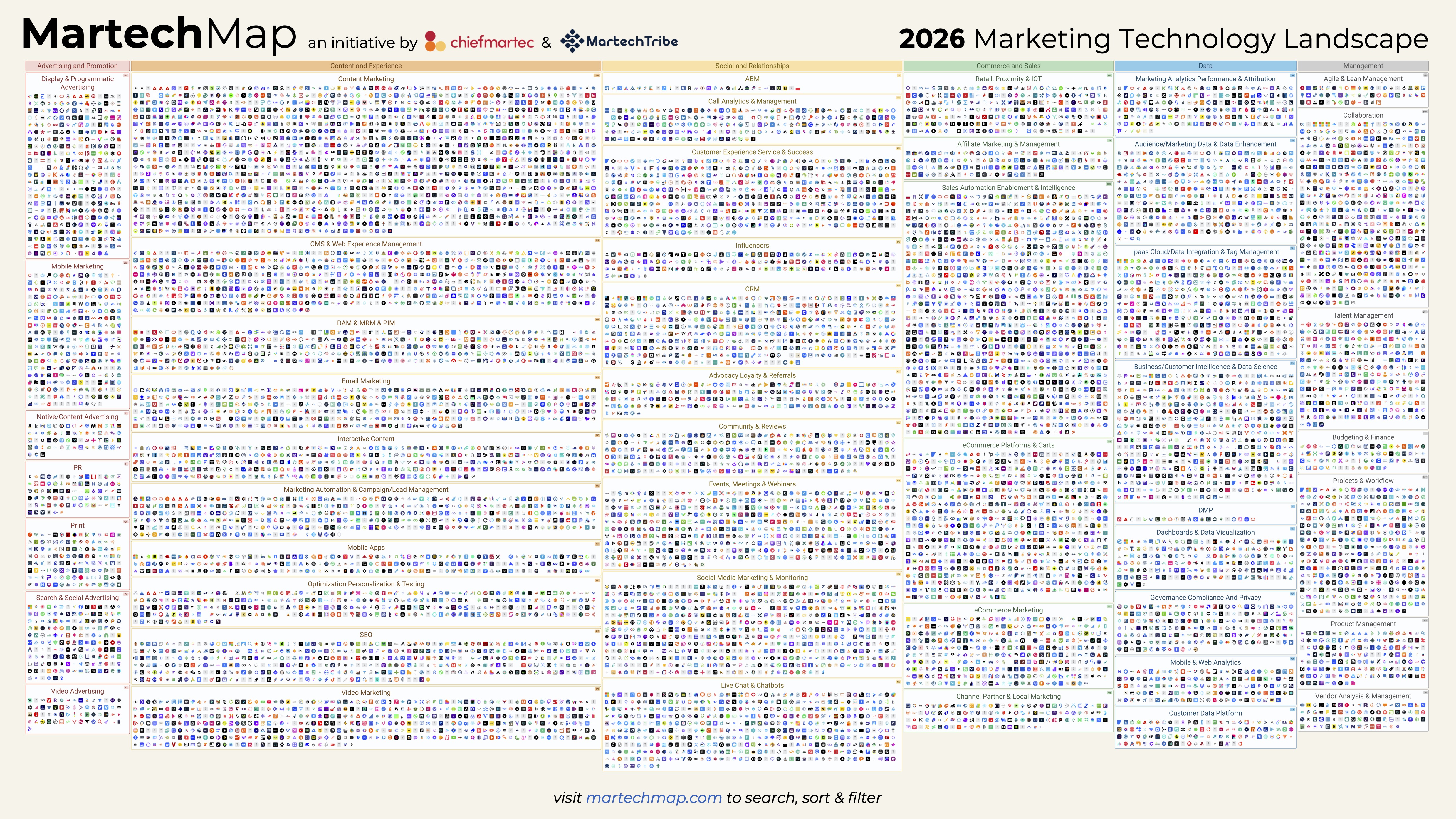
If you’ve ever seen Scott Brinker’s annual Marketing Technology Landscape, you know how overwhelming the technology ecosystem has become. Now imagine adding AI agents to that chart. At 20-point font, that may cover a football field.
The challenge has changed from finding technology that can solve a problem to finding out which technology is the right fit.
How do you make sense out of figuring out which route to take? Should you use an app? Use an AI-powered feature inside a platform you already own? Buy an AI agent? Or build one yourself?
There are a lot of nuances to consider when making this decision, but a useful place to start is understanding the differences.
Start with apps
Applications are the tools businesses most commonly use and are most familiar with. They are purpose-built software designed to perform specific functions and typically integrate with your CRM, marketing automation platform, ERP, or other business systems.
One advantage of applications is predictability.
Generally, you know what you’re paying for. Most applications use a set subscription or seat-based pricing model so there aren’t any surprises. This makes applications well suited for known, repeatable processes.
For example, if you want to automatically reach out to clients before their contracts renew, the cost will remain the same no matter how many clients you have.
Applications also come with infrastructure and stability that you don’t have to build yourself. It’s maintained and updated by the vendor with documentation, security controls, and customer support. There is often a community of users who can share best practices, ask questions, and request new functionality.
But applications have limits
The disadvantage is flexibility.
Applications are designed to solve problems that many organizations have. That means they are generally very good at handling common use cases, but they may struggle when your process is unique.
There will always be an outlier. A customer segment that needs a different experience or a process that requires information from several different systems. You can often customize an application to handle these situations, but eventually you start running into the boundaries of what the application was designed to do.
This is where things get interesting.
However, AI is now being built into many of these applications, allowing them to perform tasks that previously required custom development. As those capabilities expand, the line between an application and an agent is becoming blurry.
The other limitation is data.
Most applications are designed primarily for the data they own or the data they are connected to. If you want to bring together information from multiple systems, compare it, analyze it, and then take an action based on what you find, things can get considerably more complicated.
Then there are agents
This topic can be overly complex so let’s narrow down the definition of an agent for this article:
An AI-powered program or process designed to perform a specific function or replace a core part of an existing technology or workflow.
Examples of an agent could mean building a custom process to analyze information across multiple systems. It could mean building your own CRM, rather than using HubSpot or Salesforce. Or it could mean replacing a traditional sales outreach application with an AI-driven process.
The biggest advantage is obvious: flexibility.
AI is increasingly capable of writing code and creating processes as long as you provide detailed instructions. If you can clearly describe what you want a system to do, you can build an agent to do exactly that.
Imagine pulling customer information from your CRM, usage data from your product, billing information from your ERP, and support history from your service platform. An agent could potentially analyze all of that information and determine what action should happen next.
Historically, building something like that could require significant development resources. But AI is changing that.
And there is something undeniably satisfying about building a solution specifically for your organization rather than forcing your business to adapt to the limitations of an off-the-shelf application.
Although there’s a lot of flexibility, this comes with responsibility.
The hidden cost of building
Building an agent may be easier than it used to be, but that doesn’t mean it’s easy. You still need to understand what you’re building.
An effective agent requires someone who can think through the variables, exceptions, permissions, data sources, dependencies, and potential outcomes. If an important scenario is overlooked, the system may make the wrong decision at scale.
There is also a cost model to consider.
AI agents typically consume credits or usage-based resources. Building and testing them may require AI usage, and running them can create ongoing costs every time they perform a task.
Those costs may be relatively small today. But unlike a one-time development expense, they continue for as long as the process is running.
And then there’s maintenance. Building something is fun, but maintaining it six months later is less so.
Someone needs to document how the agent works, monitor it, update it when underlying systems change, and make sure it continues producing the intended results.
And as organizations build more and more agents, another problem emerges: agent sprawl.
Just as companies once accumulated dozens or hundreds of SaaS applications, they may soon find themselves with dozens or hundreds of AI agents operating across the business.
Who owns them? What data can they access? What happens when two agents make conflicting decisions? These are operational questions, not just technical ones.
So which should you choose?
The answer isn’t necessarily applications or agents. In many cases, the smartest technology strategy will involve both.
An application may be the right choice when you have a well-established process, predictable requirements, and a solution already exists that does the job well.
An agent may make more sense when your requirements are highly specific, your process crosses multiple systems, or an existing application simply can’t provide the experience you need.
And sometimes the best answer is neither. Before buying or building anything, ask a more fundamental question: Do we actually need another piece of technology to solve this problem?
That question matters because technology can easily become a substitute for fixing the underlying process. If your data is a mess, an AI agent probably won’t fix the root problem. If your sales process is poorly defined, automating it may simply help you do the wrong thing faster. If nobody knows who owns a process, adding another tool probably won’t solve the ownership problem.
Technology should support a good process, not compensate indefinitely for a broken one.
The technology landscape is only getting more complicated
We are entering a world where the distinction between software, automation, and AI will continue to disappear.
Applications are becoming smarter. Agents are becoming more capable. And businesses have more options than ever for building their own solutions. That is exciting. But more options don’t necessarily make technology decisions easier. In fact, they make technology strategy more important.
At Measured Results, we’ve worked with hundreds of organizations to evaluate their technology ecosystems, connect systems, improve processes, and determine where technology can create the greatest impact.
Sometimes that means implementing a new application. Sometimes it means building something custom. And sometimes the right answer is to stop adding technology and get more out of what you already have.
The goal isn’t to use the newest technology.
It’s to create the right experience for your customers, prospects, and teams with the right combination of tools, processes, and people.
The question isn’t “What can AI do?” It’s “What should we use AI to do?” And increasingly, that’s the question worth asking before you buy or build anything.